
St. Lucie County Arrest Windows
The St. Lucie County Sheriff's Office runs the main official view of who gets booked into the county jail. Its direct inmate search covers people currently incarcerated. Entries may remain through five days after release. That window suits new St. Lucie County arrests and a short lookback, not a full arrest history. The same screen offers an "Only Todays Bookings" control. Updates arrive periodically and details change fast, so a missing name never proves that no arrest occurred.
The official sources split recent activity into distinct windows. Each one answers a different question about county arrests.
| Window | Best source | What it covers |
|---|---|---|
| Same day | Daily Arrest Report | The roster’s today-only filter, current profiles, and the official affidavit page |
| Several days | Weekly Arrest Log | Fort Pierce’s selective weekday blotter, Sheriff archive checks, and news summaries |
| Recent releases | 48-hour Release Report | People leaving county custody, not a new-booking list or case result |
| One person’s status | VINELink Inmate Check | Custody status and optional release or transfer alerts |
When New Arrests Appear
An arrest and its public booking entry rarely appear at the same instant. Intake staff must book the person first. They confirm identity and log the arresting agency. The Sheriff publishes no guaranteed update interval. Someone arrested last night may stay off the roster for hours, while a fast release can leave the name easier to find in the release report or through a records request.
Agency ownership matters too. The Sheriff’s Amendment 6 notice says SLCSO posts affidavits only for arrests made by its own deputies. Fort Pierce Police, Port St. Lucie Police, FHP, FWC, and other agencies produce their own. That split shows on the roster. The jail can hold the person while another agency keeps the narrative report.
The Sheriff’s official home page lists county services.
This image marks the agency hub. Use the linked live page for current notices and navigation.
Search the St. Lucie Arrest Roster
The official St. Lucie inmate search is the best starting point for fresh bookings, current custody, and a short post-release window. It takes partial first and last names. The page also tells users to type a percent sign in the last-name field to list every inmate. Broad searches can return a crowd. Check the profile itself before assuming an exact identity. A name alone is not enough to pin down who was arrested.
| Search or profile field | How to use it |
|---|---|
| Partial first or last name | Find spelling variants, then confirm the correct person on the profile |
| Only Todays Bookings | Narrows the roster to the same-day interface view |
| Inmate ID | Use the jail identifier in later calls or records requests |
| Booking date and time | Distinguishes intake time from the time of the incident |
| Arresting agency | Shows which office should receive an affidavit or incident-record request |
| Charges, status, and bond | Point-in-time booking data, not the final court result |
| Released or expected release | Custody information that can change and is not a case disposition |
Use a careful search sequence:
- Enter a partial name or use the agency’s broad-results instruction.
- Select today’s bookings only when the search truly concerns the current day.
- Open the profile and compare date of birth, agency, booking time, and Inmate ID.
- Read each offense and bond line as booking data, then check the Clerk for later court action.
- If no entry appears, check the release report and contact the record’s actual arresting agency.
The Sheriff’s Inmate Lookup page provides the official wrapper and roster access.
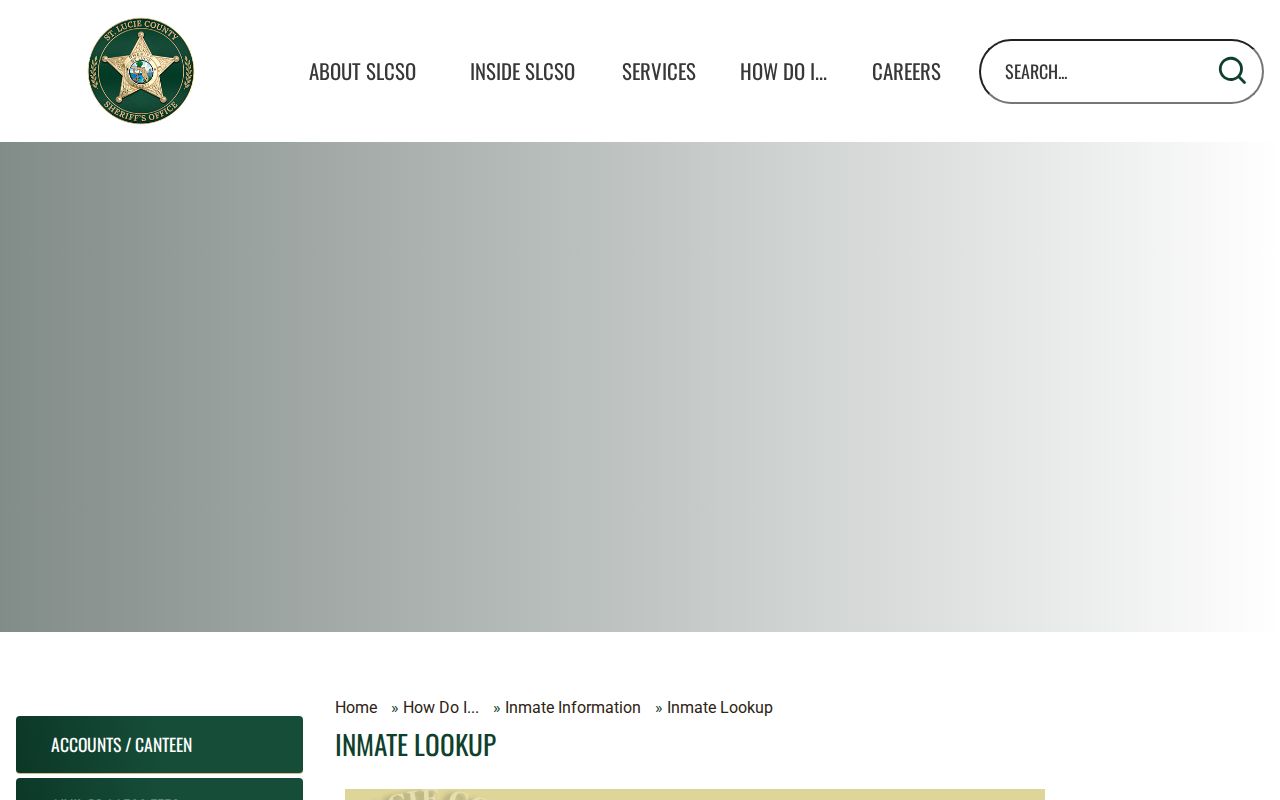
Check the live roster again whenever custody, bond, or release status matters. The sheriff's office lists no public booking-photo app. Visitation and inmate-communication apps do different jobs. Use VINELink for custody alerts rather than treating a vendor app as an arrest feed.
Where St. Lucie Arrests Get Published
Put official sources first. News and private indexes can help. They may be incomplete, stale, or wrong, and a copied booking photo can linger online after the roster, charge, or case has changed.
| Channel | Photo | Status and use |
|---|---|---|
| SLCSO jail roster | May appear on an eligible live profile | Official current custody and short post-release view |
| Sheriff arrest affidavits | Not a promised gallery | Official SLCSO affidavit path; it may be empty |
| FPPD Police Blotter | Not a complete photo feed | Official, selective weekday news blotter |
| FDC Offender Search | Yes for some state records | Official state prison or supervision data, not ordinary county bookings |
| Recently Booked, Mugshots.com | Often | Unofficial republication; verify every detail with the agency |
| Arrests.org, Mugshots.zone | Often | Unofficial indexes with uncontrolled update and retention practices |
| WPTV, WFLX, Hometown News | Varies | Independent reporting, not a complete custody database |
The Florida Department of Corrections search menu shows the distinct state-custody categories.
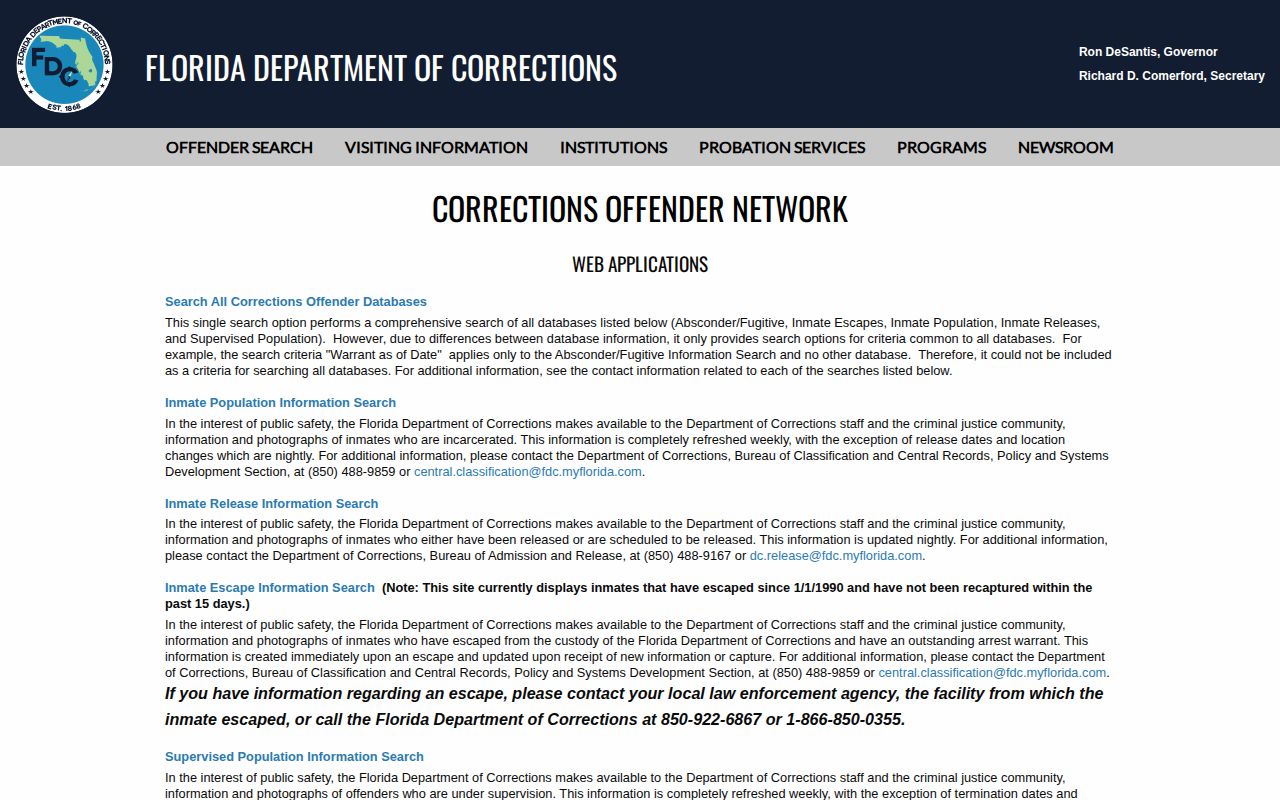
An FDC result belongs to the state prison system. Do not read it as a fresh St. Lucie County booking.
Recent Arrests by St. Lucie City
A city arrest can enter the county jail while the police department keeps the incident report or affidavit. The city pages preserve that split.
- Port St. Lucie Recent Arrests: PSLPD has no routine public daily blotter located, so use its records channel and the county roster.
- Fort Pierce Recent Arrests: FPPD publishes a selective weekday blotter, while the county jail remains the custody source.
- St. Lucie Village Recent Arrests: no separate municipal police roster was found, so identify the arresting agency first.
Port St. Lucie counted 204,851 residents in the 2020 Census. Fort Pierce had 47,297. St. Lucie Village had 613. Those figures shaped the city selection, not arrest volume, and agency statistics should never be summed into a county booking total unless their methods and periods match.
Inside a St. Lucie Arrest Record
A booking record starts at jail processing. The other layers sit elsewhere. A police report, sworn arrest affidavit, jail profile, court docket, and later correctional record are separate pieces. The official St. Lucie County profile can expose the following fields, though no single record shows every one.
| Field | What it means |
|---|---|
| Name, date of birth, age | Identity details used to distinguish similar names |
| Inmate ID | The local jail identifier, not the Clerk’s court case number |
| Arresting agency | The office that owns the affidavit or incident record |
| Booking date and time | When jail intake occurred, which may differ from incident or arrest time |
| Charge description and status | Charges recorded at booking, subject to later change |
| Bond and total bond | A release condition or amount, never a sentence |
| Housing and visitation | Current jail administration details that can change |
| Expected release and released | Custody markers, not proof that the case has ended |
| Booking photograph | The image tied to an eligible profile under current agency policy |
- Booking
- Jail intake and creation of a custody record.
- Arraignment
- A court stage where charges and plea rights are addressed.
- Bond
- A condition set for release while a case is pending.
- Disposition
- The court’s recorded outcome, such as dismissal, plea, acquittal, or conviction.
- Expungement
- Court-ordered relief that removes a qualifying record from ordinary access under state law.
The right source shifts as a case moves. Check a newly booked person through the jail. Someone released may still sit in the short roster window or the 48-hour release report. Neither source says how the court case ended. Once prosecutors file, the Clerk becomes the lasting source for hearings and disposition. Prison time moves the record to FDC. These records overlap, yet each was built for a different public function.
| Status | Record to check | What it cannot prove |
|---|---|---|
| Just booked | Today-only roster view and inmate profile | Whether prosecutors will file or change charges |
| In county custody | Live St. Lucie County Jail roster | Final guilt, sentence, or case result |
| Released | 48-hour release report, short roster lookback, and Clerk docket | That the case was dismissed or completed |
| State sentence | FDC inmate or supervision search | Every detail of the earlier county booking |
| Federal custody | BOP, ICE, or the responsible federal agency | A county booking photo or local disposition |
A sworn affidavit differs from a booking profile. It holds the arresting officer's probable-cause account. The profile records the jail's booking side. When an SLCSO profile names a different arresting agency, request the affidavit from that agency and use the booking details to identify the event. Then compare both records against the later court docket.
St. Lucie Mugshots and Arrest Photos
A booking photo may carry a prompt. The official inmate profile sometimes says "Click Image for Full Size." The details matter, though. The Sheriff's Inmate Information page limits online booking photos to people in custody at the moment of the query. The direct roster keeps entries visible for five days after release. Read those terms narrowly. A record can linger briefly, but no image is promised once someone is out.
A released person's photo can survive in a file. It can linger in an agency record long after it drops off the website. Ask the office that holds the booking or arrest record. An FDC photograph is a different animal. It attaches to state prison or supervision, not the original county booking. BOP's federal inmate locator publishes no mugshot field at all.
Private sites keep old copies too. Recently Booked posts a removal-policy route. Mugshots.zone offers one as well, though its form has failed in practice. Treat any private process as unofficial and check it live. Florida law also bars certain publishers from charging to remove an arrest booking photograph. Never pay a removal middleman on a promise alone.
Request a St. Lucie Arrest Record
The SLCSO Public Records Request page and its JustFOIA portal handle Sheriff-held material. Keep the request narrow. Name the event you need. Listing the booking card, booking photograph, arrest affidavit, incident report, and release record separately helps, since custodians and redactions vary by document.
- Identify the full name, approximate booking date, arresting agency, and Inmate ID if available.
- Ask for each needed record by name and request any disclosable booking photograph separately.
- If part is withheld, ask for the statute supporting the exemption and for all separable nonexempt portions.
- Confirm any fee before production. Florida law allows standard copy charges and a reasonable special-service charge for extensive work.
- Use FPPD or PSLPD records channels when that department created the arrest affidavit.
SLCSO promises no turnaround for booking-photo requests. Florida law wants a prompt, good-faith answer, but search, review, redaction, and volume all affect timing. Clerk requests run on their own clock. The Clerk quotes two to seven business days and lists its document fees, while the Sheriff's request portal is the direct route for SLCSO records.
Name the record and the arresting agency on the form. That lets staff route it to the right custodian.
Florida Arrest Records and Removal Law
Florida's records law starts with Florida Statute §119.07. It allows inspection and copies at reasonable times. Responses must be prompt and in good faith, with nonexempt portions separated out and released. Exemptions still shield juvenile information, victims, medical data, active investigations, and sealed material.
Sealing and expungement go through the courts. They are not simple website deletions. Florida §§943.059 and 943.0585 set separate eligibility rules. An FDLE Certificate of Eligibility usually comes first, with a $75 processing fee, roughly 12 weeks of handling, no expedite option, and a certificate good for 12 months. The St. Lucie Clerk forms page carries the local petition path. Even a dismissal or withheld adjudication does not automatically erase a booking.
Online visibility and retention run on separate clocks. Florida's GS2 schedule lists booking records and commitment-and-release lists for one anniversary year after release. Investigative files can carry longer offense-based periods. Agencies may hold records even longer than the schedule requires. For old material, ask the creating agency first, then the Clerk, and only then the State Archives catalog for a transferred historical series. A search-engine outdated-content request helps only after the source changes or vanishes.
Juvenile retention is not permission to publish. Florida's juvenile confidentiality rules control access even when a schedule keeps a record on file until a later age.
St. Lucie Arrest Warrants and Tips
SLCSO publishes no live warrant-search portal. Nor does it post a current most-wanted roster. Confirmation runs through the SLCSO Warrant Unit, located at 218 S. 2nd Street, Room B214, Fort Pierce, phone 772-462-3330. The Clerk Court Case Search shows filed cases and docket events. It cannot confirm a warrant's status.
Someone facing a possible warrant should call an attorney, the court, or the Warrant Unit to resolve it safely. Never approach or follow a person you believe is wanted. Never try to detain anyone. Call 911 for an immediate threat. Nonemergency tips can go through the Sheriff's wanted-person tip form or Treasure Coast Crime Stoppers at 1-800-273-TIPS. Those are tip channels, not warrant databases.
After a St. Lucie Arrest
The jail roster tracks custody. The court docket tracks the case. St. Lucie County Circuit Criminal handles felonies, while County Criminal covers misdemeanors, criminal traffic, and ordinance cases. Search the Clerk by name and case number when you have both. From there, review filings, bond conditions, hearing dates, pleas, trial events, and the final disposition. An Inmate ID is not a case number, and a court case may take time to appear after booking.
The Nineteenth Judicial Circuit publishes a current bond schedule. The Clerk explains cash and surety bonds. A roster bond amount is a release figure. Release can happen while prosecution continues. The Sheriff's 48-hour report, in turn, cannot answer whether a charge was dismissed, reduced, acquitted, or ended in conviction.
Custody Beyond St. Lucie Arrests
Custody in St. Lucie County does not always stay local. A person arrested here can move through several systems after booking. The Florida Department of Corrections handles sentenced state prisoners, releases, supervision, and absconders, and its search can return a photo plus a DC number. It will not show every recent county arrest, though. Photos there may come from a later stage than the booking image taken in St. Lucie County.
Federal cases run on separate tools. The BOP Inmate Locator covers federal inmates from 1982 forward and has no mugshot field at all. For immigration holds, the ICE detainee locator works for people in ICE custody or transferred from CBP beyond its stated window; search with an A-number and country of birth, or with exact identity fields. The USMS holds federal pretrial detainees and transport prisoners, often in local jails. None of these replace the county arrest roster.
The practical rule is simple. Match the locator to the current stage of custody. Check the official photo distinctions before trusting any image. When a name vanishes from one system, contact the arresting or custodial agency rather than guessing.
Transfers and update schedules leave gaps between sources. Verify the identifier and the date before treating two records as the same person.